
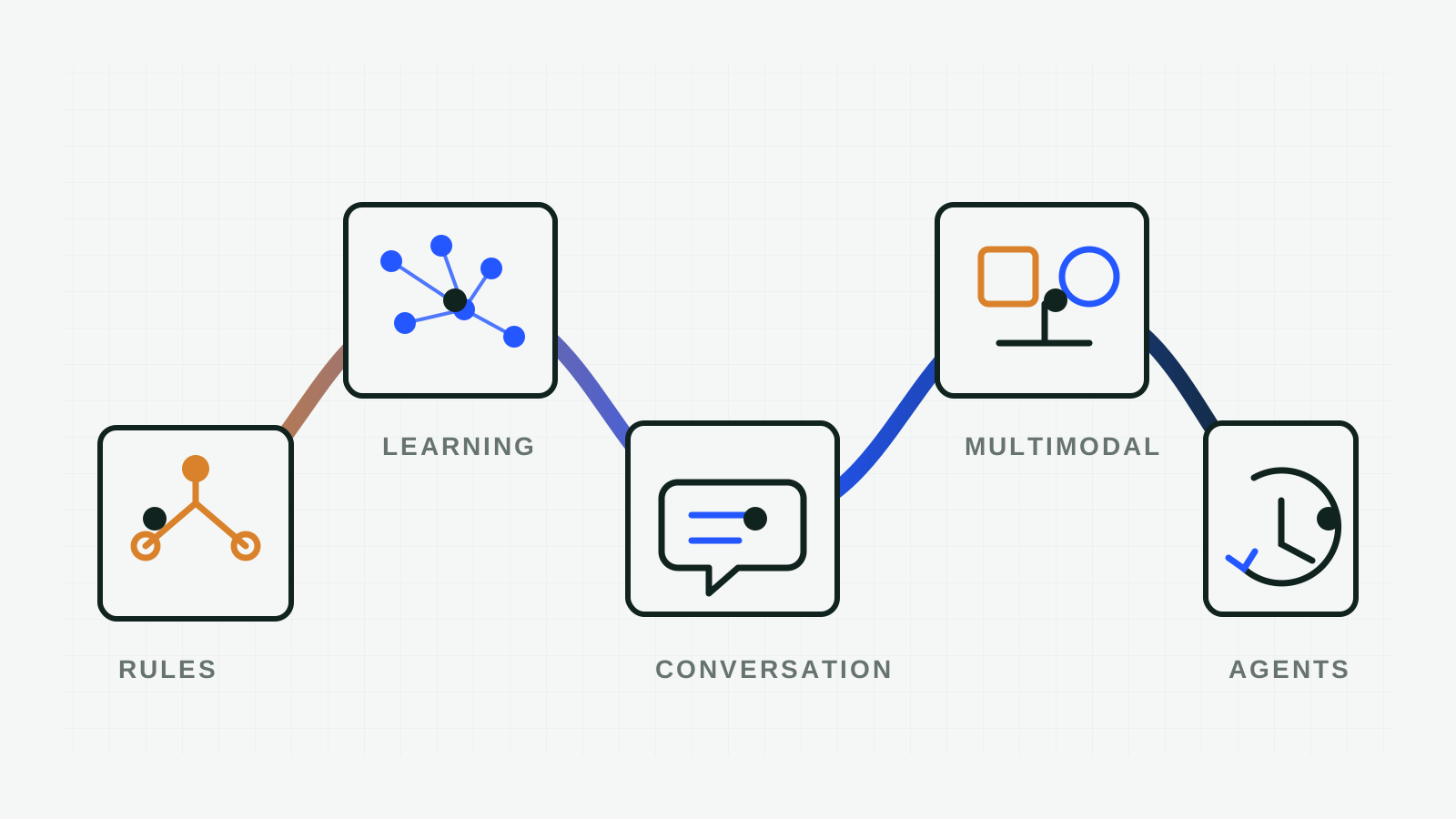
The interface changed as much as the intelligence
- 1950–1956
A question and a research field
Alan Turing framed machine intelligence as an observable question about behaviour. The Dartmouth proposal then described a research program around learning, language and problem solving. There was no consumer prompt box: AI was primarily a research problem.[1][2]
- 1960s–1980s
Rules, symbols and expert systems
People encoded domain knowledge as rules. Users usually worked through a specialist interface and the useful scope was narrow. The system could be valuable inside that boundary, but it did not become a general colleague.
- 1990s–2010s
Systems learned patterns from data
Statistical machine learning changed the job from writing every rule to choosing data, features, objectives and evaluation. Search ranking, recommendations, speech and image recognition often appeared as features inside products rather than as a conversation.
- 2017–2021
General models became easier to adapt
Transformer-based models made it practical to build stronger language systems from large-scale training and then adapt them to many tasks. Most users still reached them through APIs, product features or teams that knew how to integrate a model.[3]
- 2022–2024
Conversation became the interface
Public generative assistants let a person ask, revise and continue in ordinary language. The skill moved from operating a specialised system toward supplying context, examples and constraints—while checking results that could sound confident without being correct.[4]
- 2024–2026
Assistants gained more tools
Multimodal input, retrieval, code execution and tool calls widened the interaction beyond text generation. Agent-style systems can attempt a sequence of actions, but wider access also increases the need for permissions, approval points, logs and recovery when an action is wrong.
The early user was usually a specialist
Early AI systems were not a general destination for everyone. A researcher, engineer or domain expert defined the representation, the rules or the training process. The end user often saw a recommendation or a controlled form rather than the model itself.
That separation reduced flexibility, but it also made the boundary easier to describe. A medical, industrial or financial system could be tested for a particular input and output. Moving outside the designed domain was an obvious misuse rather than a conversational temptation.
Machine learning made AI quieter
As machine learning spread, AI became an ingredient. People used spam filters, search, translation, recommendations and computer vision without holding a conversation with a model. Product teams decided when the model ran, what data it received and how its output affected the interface.
For users, the main change was better automation inside familiar software. For organisations, the difficult work moved into data quality, evaluation, monitoring and the consequences of a wrong prediction.
Chat changed the operator
Generative chat exposed the model directly to ordinary users. A first request could be followed by corrections, examples and extra context. The user became part editor, part reviewer and part workflow designer.
This flexibility is useful, but it hides a boundary: fluent language is not proof. Current facts need current sources. Calculations need checking. High-impact legal, medical, financial, employment or safety decisions need qualified human judgement. A useful prompt does not remove the responsibility to validate the result.
Copilots put AI inside the work
A copilot is most useful when it sits beside a person in an existing task: drafting code, summarising a document, preparing a response or finding information. The person still owns the decision and can compare the output with the source material.
The practical design question is not whether a model is impressive. It is whether the tool receives the right context, keeps sensitive data inside an acceptable boundary, exposes uncertainty and leaves the user a clear way to reject or correct the result.
Agents change the risk from words to actions
An assistant returns content. An agent may search, call an API, edit a record or trigger another system. That can remove repetitive steps, but a plausible mistake can now change real state.
Start with the smallest authority that can complete the job. Use read-only access before write access, a sandbox before Production, and approval before irreversible actions. Record what the system attempted and keep a deterministic fallback.
- Name one narrow outcome and an accountable owner.
- Limit data and permissions to that outcome.
- Require human approval for money, people, access, publication and destructive changes.
- Measure exceptions and recovery—not only successful demos.
Choose the smallest interaction that works
Use an ordinary rule or integration when the input and outcome are deterministic. Use a model for classification, extraction or generation when variation is the point. Use chat when a person should steer the result. Use a copilot when the person remains inside the workflow. Consider an agent only when the value of multiple actions outweighs the extra permission and recovery burden.
The history of AI is not a straight march toward removing people. It is also a history of changing interfaces. The durable question is who supplies context, who checks the outcome and who remains responsible when the system is wrong.